
Remembering Shamcher Beorse
Welcome to Sufi Circle Canada Chronicles, featuring new articles, and revisiting earlier pieces published in the Heart to Heart Newsletter.

In this issue we remember our remarkable Sufi friend, mentor and catalyst, Shamcher Bryn Beorse. This post is gathered together by Carol Sill, with a main article by Nirtan Sokoloff, followed by news clips and a quote found by David Murray. This remembrance expands into the UPDATES section, announcing Rani’s new memoir, God Who? and Nirtan’s latest music release, Catch a Rising Wave.
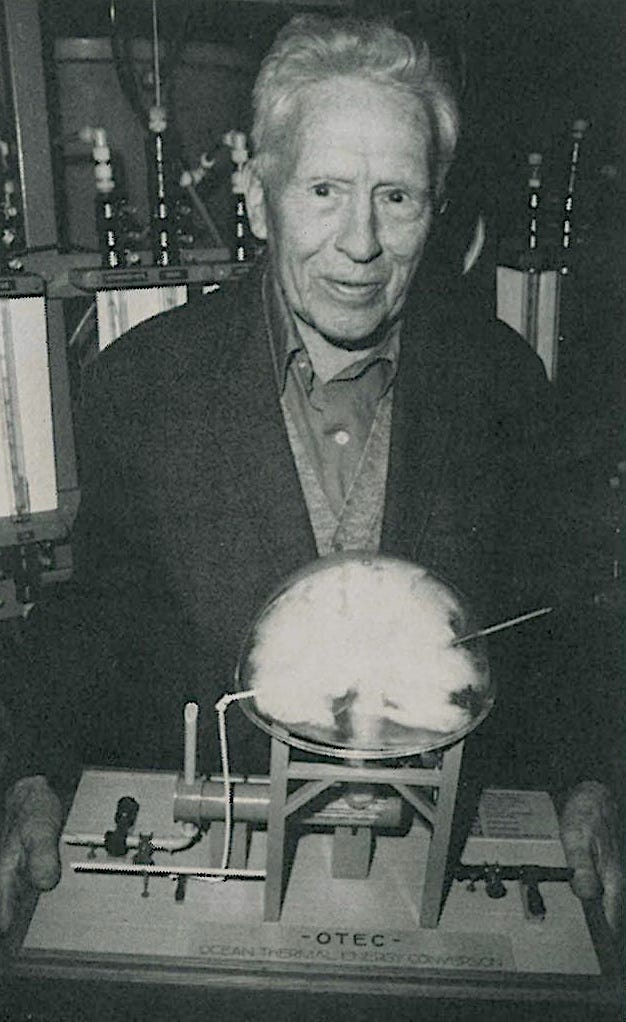
Shamcher Week
by Carol Sill
The end of April is always significant to those who knew Shamcher.
Shamcher was born on April 26th in Norway in 1896. As a pupil of Hazrat Inayat Khan in the 1920s, he attended Summerschools in Suresnes and was first active in the Sufi centre in Christiania (now Oslo.) His work as an engineer and economist took him throughout the world, where he performed Universal Worship and encouraged Sufi activities wherever possible (or even impossible.) As a spy in WWII, Shamcher volunteered for many dangerous missions, saying that at age 44 he had lived his life, and the younger men should be given a chance to do the same. Settling in California after the war he wrote books on economics and worked on research for the promising OTEC system of benign solar power from the sea. With Murshid Sam Lewis and Saladin Paul Reps, Shamcher was one of the few original pupils of Inayat Khan in the Bay Area at that time. (It wasn’t until much later that he met Hayat Stadlinger.) Shamcher always said he didn’t believe in a fixed outer teacher/disciple relationship, yet he was devoted to HIK his whole life, and had many loving students, often with widely divergent views and affiliations.
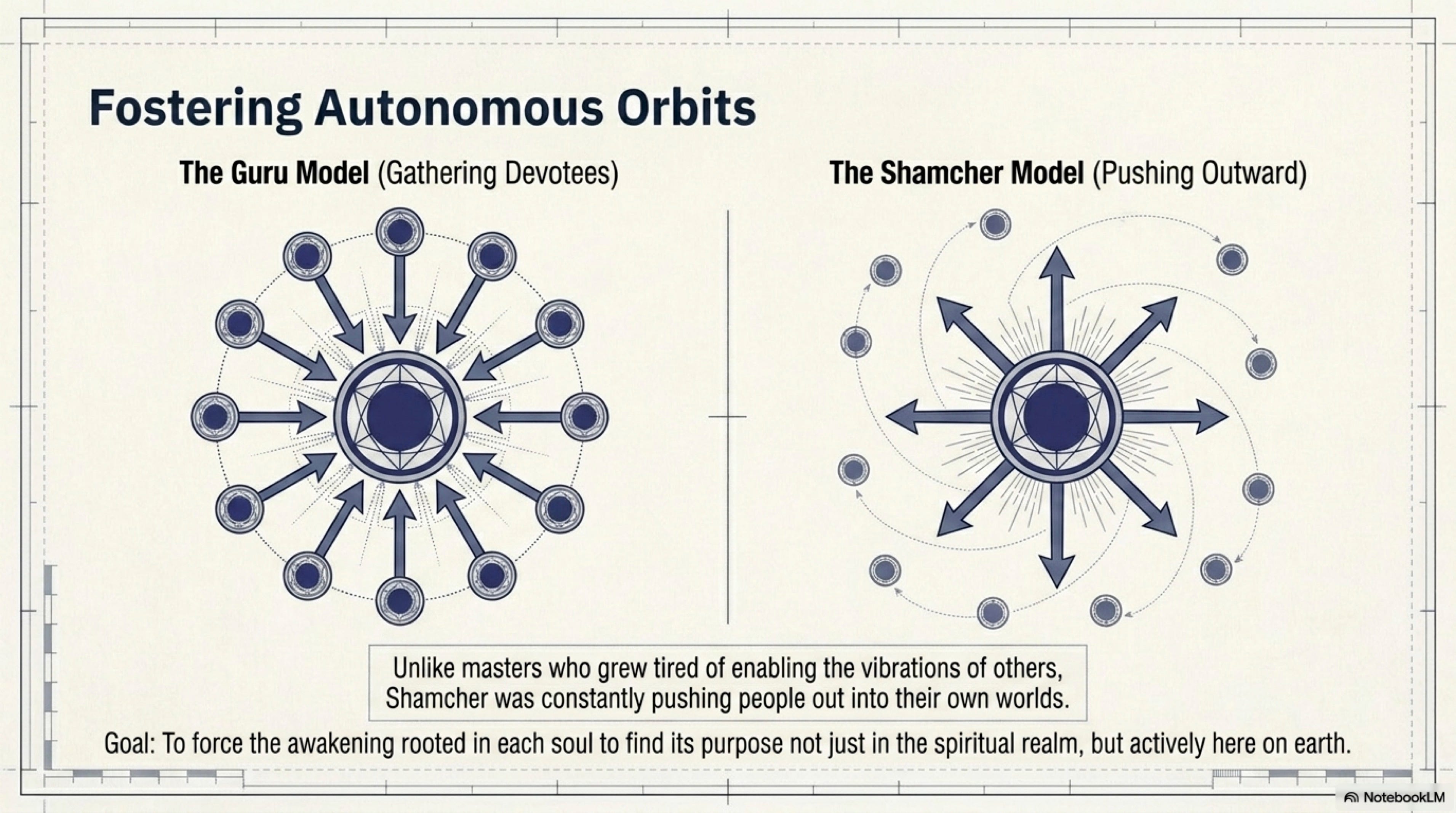
Shamcher’s multifaceted life integrated spiritual wisdom with his diverse professional disciplines. As an intuitive “engineer of consciousness,” he blended his background in infrastructure and economics with his role as a Sufi and yogi. He operated as a generalist, authoring books on topics ranging from geopolitics to fairy tales, always advocating for a world where humanity evolves beyond economic and political constraints. Shamcher emphasized the importance of finding individual soul purpose and maintaining a connection to the divine mind, asking for protection from God in your heart.
As the years go by since his passing in 1980, Shamcher can be seen as a visionary figure. His vast, interconnected legacy continues to offer a roadmap for human evolution and spiritual awakening.
Shamcher’s Worldly Work
by Nirtan Carol Sokoloff
They say the Sufi is “In the world, not of it,” and Shamcher Bryn Beorse certainly exemplified that attitude. With a master's in Engineering, his work took him from military applications to service as a presidential economic advisor to pioneering Ocean Thermal Energy Conversion (OTEC), a large-scale solar energy technology promising clean, unlimited and low-cost energy.
I first met Shamcher in June 1977 at a Sufi camp held north of Toronto. Run largely by Shahabuddin Less of the then Sufi Order, Shahabuddin had invited Shamcher to be among the teaching staff. How wonderful that he accepted the invitation! Meeting Shamcher, then 80 years of age, had a profound effect upon me. He had been a student of Inayat Khan in the 1920s and, to me at least, conveyed a whole different understanding of Inayat’s universal Sufi Message, one I had intuited although not particularly evident in my exposure to Sufi teachings up to that point. So it was toward Shamcher’s mystical side that I was first attracted.
During that summer I wrote him a letter and was thrilled to receive a very touching reply. He was at the time recently retired from his work on a defence base in Washington State and about to return to the University of California at Berkeley, where he had previously held a position in the Seawater Conversion Lab. There he resumed the development of a working OTEC model he had started years before. Later that summer, a family situation unexpectedly also took me to California, and I had a chance to spend more time with Shamcher and his wife Evelyn in their Berkeley apartment.
Shamcher was convinced that, given the chance to develop, OTEC could be an important and benign large-scale energy source. It needed only a warm ocean surface to act as giant solar collector. Then the temperature difference between that warm surface and colder lower layers of the ocean was enough to power a steam engine for energy creation. The only waste product of the technology was valuable desalinated water! Shamcher understood that any limited resource such as oil was prone to fluctuating and inflated values based on accessibility and demand. Nuclear power was in favour as a peaceable use for the technology that went into devastating nuclear weapons, but Shamcher knew that it would never be entirely safe nor clean, the nuclear waste simply had no safe disposal solution.

OTEC was clearly a wonderful option and yet scientists working on it met a deaf ear when they repeatedly tried to interest government bodies in promoting this technology. Shamcher had served on an economic advisory committee for President John F. Kennedy. He was quite comfortable dealing with those in positions of power and in the past his viewpoints had been well appreciated. However, when it came to OTEC he found himself and his colleagues working on the technology unable to sway the politicians and decision-makers. They preferred to heed those with no experience or knowledge of the technology, who disparaged it as riddled with difficulties or impossible.
Thus, through a degree of desperation, Shamcher turned to those close to him, a rag tag group of sufis who appreciated his mystical awareness, to see whether we could not stimulate greater interest in a technology which could literally save the world. I was among the group that took part in a non-profit Shamcher created, Alternative Directions in Energy and Economics. He helped us understand both the need for OTEC and its workings, and we tried our best to support his tireless efforts to get through to those in control of these massive projects.
Through my contact I began to see that Shamcher had become disillusioned with the politicians and government officials who dismissed the work of the most informed scientists in the field, choosing to listen to the uninformed. Shamcher had always been a respectful participant in government, serving in the war as an intelligence operative, later working for the military. But I sensed Shamcher began to understand that perhaps politicians and bureaucrats were not working for the common good, that other forces were at play - he was up against some kind of agenda.
In the end through Shamcher’s efforts the Carter administration funded a small OTEC pilot project off of Hawaii. The election of Reagan in 1980 saw its immediate demise. Shamcher also died in April 1980, perhaps hopeful that OTEC would go on to benefit the citizens of the planet with plentiful, low-cost benign energy. Or perhaps he was aware that the fix was already in and this knowledge may have taken away his will to live.
It was a privilege to be close to Shamcher during the founding of ADEE and it has given me a perspective on what might have been possible. Forty-five years later we certainly could have had OTEC plants supplying large amounts of energy, enriching both the developed and less developed countries of the global south and supplying fresh water to drought-stricken regions. With abundant energy would have followed the economic conditions Shamcher considered ideal for the fulfillment of human potential – full employment in meaningful work, sufficient income to foster a compassionate society where individuals could work for both their own and another’s benefit, with sufficient leisure to attend to both worldly and spiritual pursuits.
It is shocking to me that in our age we have governments and global institutions supposedly concerned about the environment and planetary conditions who propose (and sometimes mandate) poorly thought-out solutions, based on unproven science and limited in scope, when OTEC’s promise of clean, benign and low cost energy has never even been tried. Imagine the kind of world we could be living in had Shamcher’s wisdom and the experience of the many scientists delving into OTEC technology received greater acceptance.
I’ll end with a quote from Shamcher, the truth of which becomes even more profound over the years. Speaking in the late 1970s after a period of oil scarcity, a so-called ‘energy crisis,’ Shamcher said, “We don’t have an energy crisis, we have an ignorance crisis.” Inayat Khan also used the word “ignorance” as part of the Universal Worship service he and early mureeds created, when a candle is lit to “All those, whether known or unknown to the world, who have held aloft the light of truth, through the darkness of human ignorance.” The word ignorance means one is ignoring something or choosing not to give our attention to a certain thing. Shamcher worked tirelessly to raise interest in a technology that held tremendous promise for humanity.
Having read Inayat Khan’s writing on ‘the purpose of life’ I remember a conversation in which I mentioned that, at 26 years of age, I hadn’t a clue about the purpose of my life. Shamcher reassured me that in his eighties he had only recently come to understand the purpose of his own life. I have no doubt it included bringing OTEC technology to the planet.
Shamcher and OTEC in the News
by David Murray
Here’s a sample of the many news articles our research has uncovered. (Link through the article image to read a larger view.)
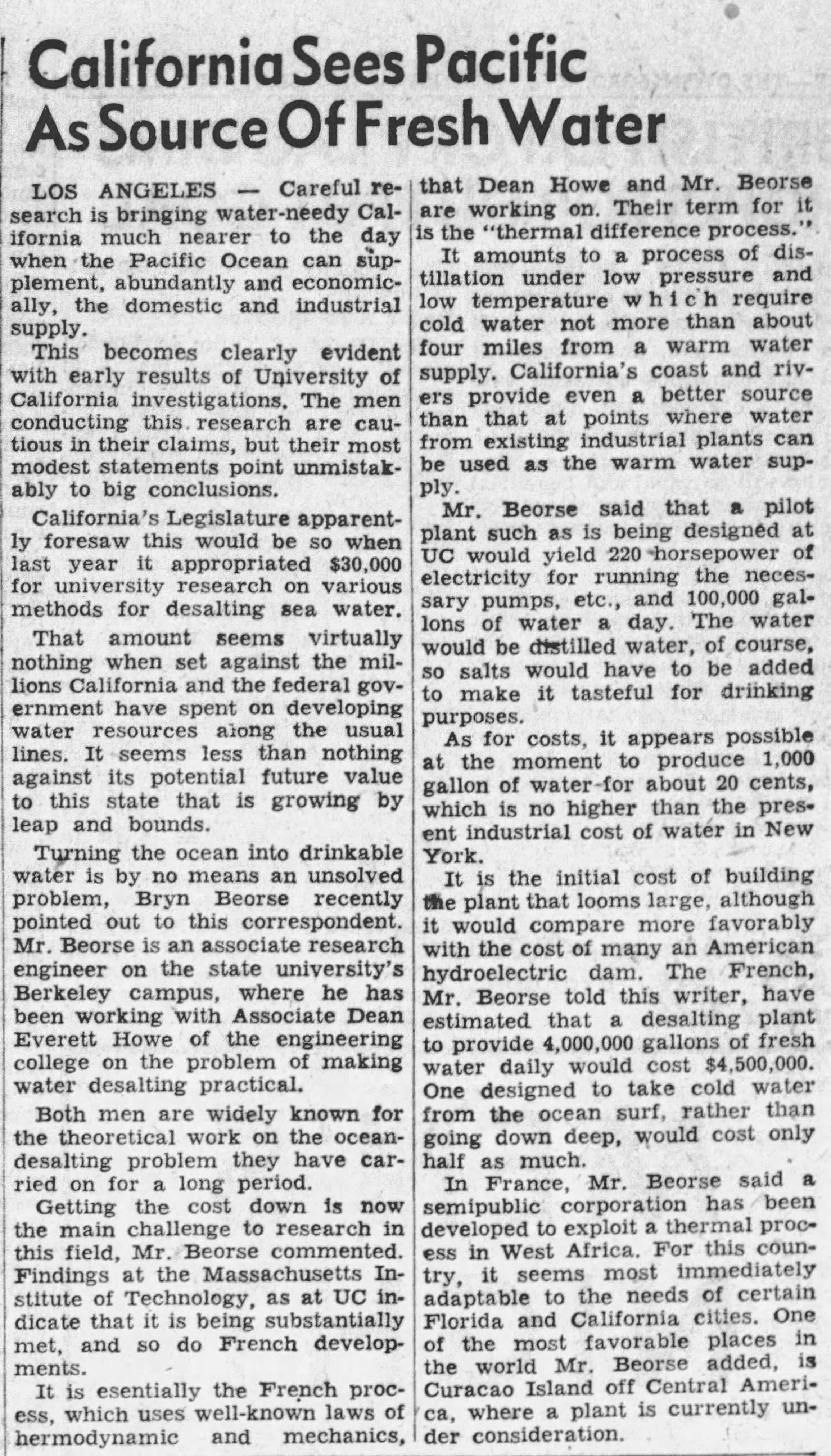
This article from the Owensboro Messenger, December 11, 1952, is one of the earliest public accounts of Shamcher’s research into harnessing ocean water thermal differences. His early efforts were turning the ocean into drinkable water using the thermal difference process to generate electricity for the distillation process.
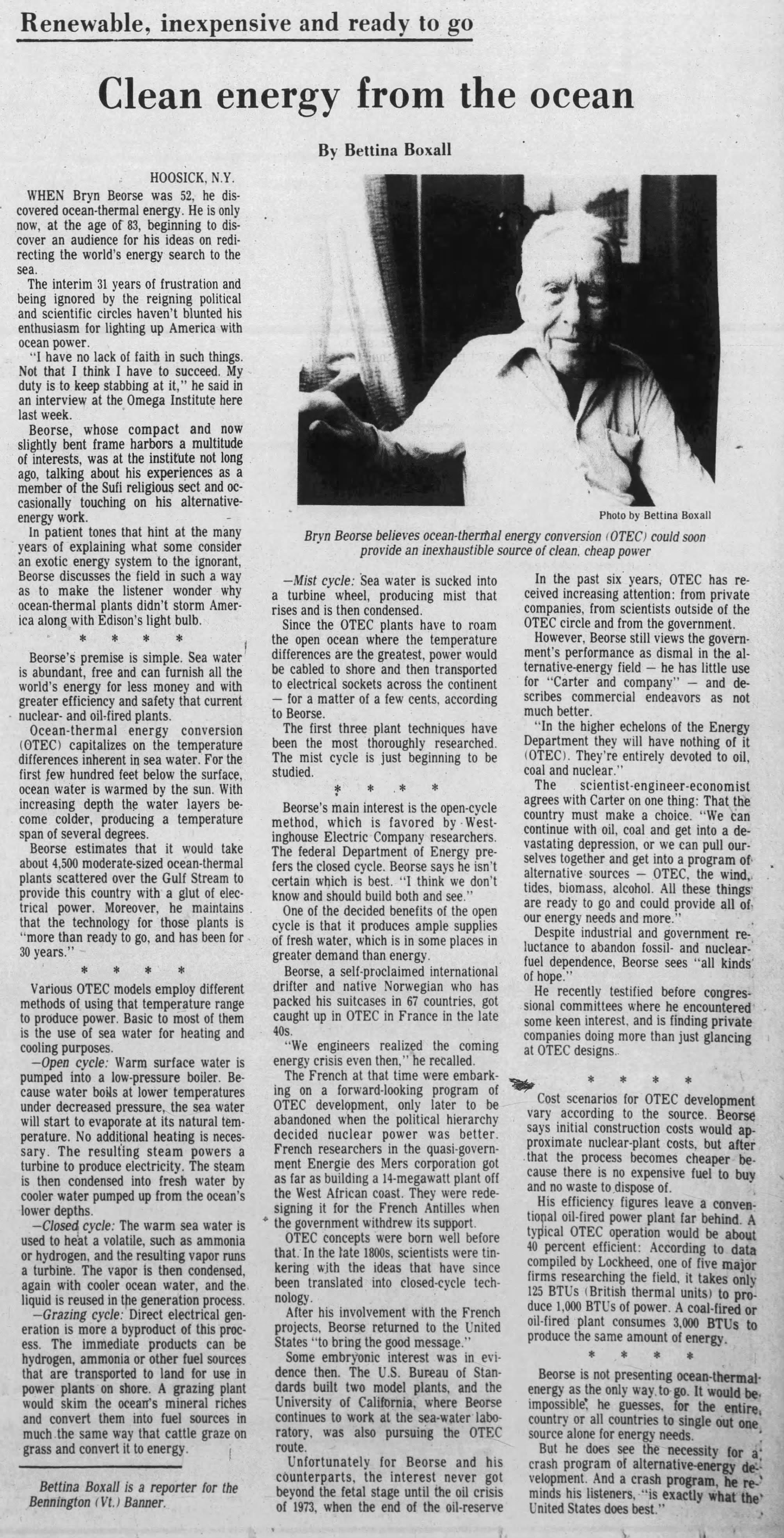
This piece from The Berkshire Eagle, August 17, 1979, describes in detail Shamcher’s research into Ocean Thermal Energy Conversion as an alternative to oil, coal and nuclear energy.
The Kitsap Sun, August 12, 1972, offers a public exploration into Shamcher’s life and his devotion to and admiration for the Sufi Message of Hazrat Inayat Khan.
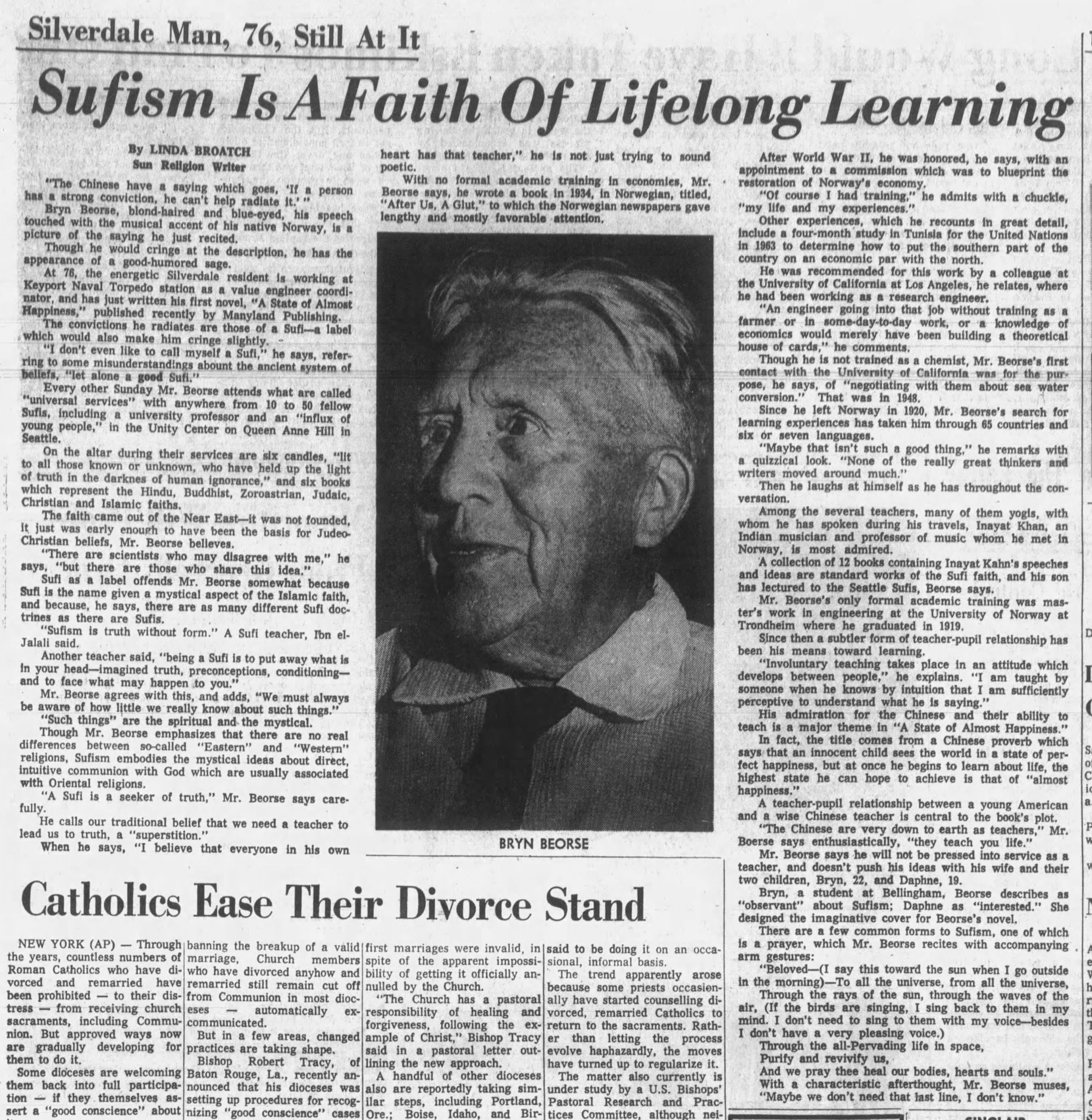
We’ll share more articles in future issues.
Also from David: I thought that this passage below might speak to a deeper understanding of Shamcher. 1924 Complete Works of Hazrat Inayat Khan, Vol 1 page 16+
Often people have imagined that to be a mystic means to be an ascetic, that a mystic is someone who dreams, a person who talks in the air, someone who does not live here on the earth, a person who is not practical, who is an ascetic, a hermit. But that is not the case in reality.
Very often people want to see a mystic in a peculiar man, and if there is someone peculiar, they think that this is a mystic. But that is a wrong conception. That is not proper mysticism, but exaggeration; it is one-sidedness. A real mystic must show equilibrium; a true mystic strikes balance in his life, his head in heaven, his feet on the earth. He is the knower of both worlds, this world and the next. It does not mean that a mystic is absent from this world. He is as wide awake in this world as in the other. A mystic is not someone who does not possess intellect. Intellect is his weapon. He is not someone who dreams; he is wide awake. Yet a mystic is someone who is capable to dream when others cannot, and a mystic is capable to keep awake when others cannot keep awake. A mystic strikes balance between two things, power and beauty. Neither does he sacrifice power for beauty, nor beauty for power. He possesses power and enjoys beauty.
As to the restrictions in the life of a mystic, there are no restrictions. There is balance, reason, love, harmony and beauty. The religion of the mystic is every religion, all religions, and yet he is above what people consider religion. In the point of fact his religion is the religion, for it is not any religion, it is all religions. The moral of the mystic is reciprocity, beneficence and self-sacrifice: to reciprocate all the kindness he receives from others; to do an act of kindness to the others without meaning to have an appreciation or return for it; and to make every sacrifice, however great, for love, harmony and beauty. The God of the mystic is to be found in the depth of his own heart; the truth of the mystic is beyond words. People discuss over things of little importance.
For to a mystic it is not a discussion, it is a passion. People want to talk, therefore they talk. Very often it is not the one who knows who talks, it is the one who does not know who talks. But by discussing he wants to know. Yet he is not sure. The one who knows needs no discussion. He knows. His happiness is his own.Besides to put the truth into words is like putting the ocean in a bottle.
A mystic who becomes thoughtful, kind and sensitive, how does he get on amidst the everyday life, for the rough edges of daily life break against his heart and must necessarily make it sore? Certainly they do. The heart of the mystic is more sore than the heart of anyone else.
For the reason is where there is give and take in the roughness of daily life, the heart is not sensitive; it gives blow for blow. But when the heart is always patient and kind and full of sympathy, then it only takes all the roughness and never gives it back. It cuts the heart to become a cut diamond. And by being cut it becomes brilliant and when it is sufficiently cut, it becomes a flame, illuminating the life of himself and the lives of others.
Discover links to more on Shamcher after the Updates

UPDATES to April 26, 2026
Please let us know if you have an announcement, news, recollection, or book or music release you’d like to share.
New! Book Release

Our long-time Sufi friend in Portland, Oregon, Murshida Rani Kathleen McLaughlin, has written a personal memoir titled, God Who?

She asks, What is your path to God? - Become Your True Self. Drawing from her extensive journals, Rani shows how she understood the teachings of Ram Dass, Buddhist meditation and psychology, and the universal Sufi Message of Hazrat Inayat Khan. “We must keep asking ourselves the question, God Who? as we walk the path of mystical realization.” Now available as an ebook or paperback. Link here for further info and how to buy.
New Music from Nirtan
Catch a Rising Wave - just released! Take a moment to listen to another sweet Nashville-recorded song from Nirtan Carol Sokoloff’s upcoming album, Change in the Weather. Click on the wave for a teaser, and links to get the music on Spotify or Apple Music. Or hear the whole song on YouTube below. (In the world of music streaming and algorithms, it really helps when people listen all through.)

Links for More on Shamcher
At the official Sufi Circle Canada website, read the overview, Shamcher Bryn Beorse | His thoughts, His Life.
Catch up with all things Shamcher at The Shamcher Bulletin, a free intermittent Substack publication from his archives. Subscribe for free, add comments, suggestions and memories.
Books by Shamcher are available on Amazon worldwide and at shamcher.com, where each book is fully listed with more details.

It is great know that these stories of remarkable sufis are being seen. Its a pleasure to remember them and how they were all guided by the sufi message of love, harmony and beauty.
Great to make this connection. Thanks for the comment.